


Leather earrings are popular across the EU for their lightweight design, creative styles, and customisable appearance. However, making high-quality leather earrings is not always easy. Achieving symmetrical shapes, smooth edges, and accurate cut-outs often depends on the production method you choose.
Currently, the two main approaches are hand cutting and laser cutting. Traditional handmade methods are affordable and beginner-friendly, while laser cutting delivers greater precision, faster production, and more consistent results for intricate patterns.
In this guide, we compare both methods, explain their advantages and limitations, and show why many EU hobbyists and small craft businesses choose laser cutting machines for efficient and professional leather earring production.

In this article:
- Part 1: Why Do Leather Earrings Stand Out
- Part 2: Two Popular Methods for Making Leather Earrings
- Method 1: Hand Cutting
- Method 2: Laser Cutting
- Part 3: How to Make Leather Earrings with Laser Cutting
- Part 4: Tips for Making Leather Earrings with Laser Cutting
- Part 5: FAQs about Making Leather Earrings
Part 1: Why Do Leather Earrings Stand Out?
Leather earrings are widely appreciated across the EU for their combination of comfort, creativity, and customisable design options. Compared with heavier accessories made from metal or resin, leather earrings are lightweight and comfortable enough for everyday wear.
Key Benefits of Leather Earrings
Many makers and fashion enthusiasts choose leather earrings because they offer:
- Lightweight wearability for daily comfort
- Flexible material properties that support intricate shapes and layered designs
- Strong compatibility with colouring, engraving, and mixed-media decoration
- Easy customisation for personalised fashion accessories
Leather is also highly suitable for laser cutting technology. In the EU, many hobbyists and small craft businesses use laser cutters to achieve more precise cuts, cleaner edges, and consistent production quality for leather jewellery.
Who Should Wear Leather Earrings?
Leather earrings are suitable for:
- DIY jewellery makers
- Handmade fashion enthusiasts
- Online craft sellers and small businesses
- People who prefer lightweight and modern accessories
From minimalist geometric patterns to bold artistic designs, leather earrings can match a wide variety of fashion styles and age groups.
Part 2: Two Popular Methods for Making Leather Earrings
There are currently two main methods for making leather earrings: traditional hand cutting and laser cutting. Each approach offers different advantages in terms of cost, precision, workflow efficiency, and production quality.
Method 1: Hand Cutting
Hand cutting involves using basic tools such as scissors, craft knives, leather punches, and cutting templates. Makers draw the design onto the leather manually before cutting out the shapes and punching attachment holes for earring hooks.
This method is often chosen by beginners because the startup cost is low and no digital software is required. It also provides a more traditional handmade crafting experience.
However, hand cutting can become challenging when producing detailed or repeatable designs because:
- Precision depends on manual control
- Symmetrical shapes are harder to reproduce consistently
- Complex patterns require more time and patience
- Batch production efficiency is limited
For small DIY projects, hand cutting remains a useful and accessible option.
Method 2: Laser Cutting
A laser cutter uses a digitally controlled laser beam to cut leather accurately according to a design file. In a single workflow, the machine can cut shapes, create hook holes, and add decorative details with clean and consistent edges.
A laser cutter commonly used for leather crafting usually supports both laser cutting and laser engraving functions. In addition to cutting precise outlines, it can engrave patterns, textures, names, or branding elements directly onto the leather surface. Since the process is computer-controlled, designs can easily be resized, copied, or modified without creating new templates manually.
For leather earrings, laser cutting offers several important advantages:
- High precision for intricate and delicate designs
- Clean edges with minimal manual finishing
- Faster production workflow
- Consistent quality across multiple pairs
- Efficient small-batch and business production
The process is also beginner-friendly compared with traditional manual crafting methods. Many EU hobbyists and small craft businesses choose compact machines such as the LaserPecker LP2 Plus because they combine precision, ease of use, and production flexibility.
In the EU, laser cutting is also valued for its ability to support customised jewellery production while maintaining consistent design quality.
Hand-Cut vs Laser Cutting: How to Choose?
| Aspect | Hand-Cut Method | Laser Cutting Method |
|---|---|---|
| Precision | Skill-dependent | Highly accurate and consistent |
| Design Complexity | Basic to moderate | Supports intricate designs |
| Speed | Slow for repeated work | Fast and repeatable |
| Consistency | Can vary | Highly uniform |
| Customisation | Manual detailing | Cutting + engraving |
| Best For | DIY crafting | Professional or scalable production |
Overall, laser cutting is generally the preferred method for making leather earrings, especially for users who want precise results and efficient production.
Compared with manual cutting, using a laser cutter such as the LaserPecker LP2 Plus not only improves cutting accuracy but also enables personalised engraving within the same workflow. This allows makers to create detailed, repeatable, and professional-looking leather jewellery more efficiently.
Part 3: How to Make Leather Earrings with Laser Cutting
Laser cutting combines modern technology with handmade creativity, allowing users to produce detailed leather earrings with high precision and consistent quality. Compared with traditional manual cutting methods, a laser cutter can create shapes, hook holes, and decorative details far more accurately and efficiently.
For leather earrings, laser cutting offers several clear benefits:
- Smooth and clean cutting edges
- Precise and repeatable shapes
- Faster production for multiple items
- Easier creation of intricate patterns
- Minimal manual finishing after cutting
Because the process is digitally controlled, even beginners can create professional-looking leather jewellery without extensive crafting experience.
Why the LP2 Plus Is Suitable for Leather Earrings
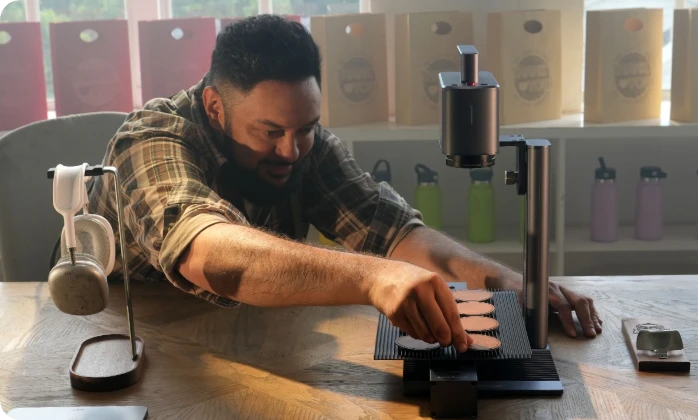
Selecting the right machine is essential for achieving reliable results. The LaserPecker LP2 Plus is popular among EU hobbyists and small craft businesses because it combines portability, precision, and flexible engraving functions in a compact machine.
Main advantages include:
- Precision Cutting: Produces sharp edges and detailed cut-outs for intricate earring designs
- Multi-Material Compatibility: Supports different leather thicknesses without changing tools
- Laser Cutting + Engraving: Allows cutting and surface engraving within the same workflow
- Portable Design: Flexible positioning supports both flat and curved surfaces
- Efficient Batch Production: Delivers consistent quality for repeated or small-batch designs
For safer indoor use, the LP2 Plus can be combined with the LaserPecker Standard Enclosure to achieve Class 1 Laser Safety protection. Users can also pair the machine with the LaserPecker Desktop Smoke Purifier, which helps filter smoke, odours, and particles generated during laser engraving and cutting. This makes indoor crafting environments cleaner and more comfortable, especially for home studios and small workshops.
These features make leather laser cutting not only precise and efficient but also highly suitable for customised jewellery production.
Step 1: Select Suitable Leather
Natural leather and vegetable-tanned leather are commonly recommended for laser cutting projects. Thin leather between 0.8 mm and 1.5 mm is ideal because it keeps earrings lightweight while remaining easy to cut.
Avoid PVC-coated or heavily treated leather materials, as they may release harmful fumes during laser processing.
Step 2: Design the Earrings
Create the design using graphic or vector software. Depending on your style, you can make minimalist shapes, layered earrings, hollow geometric patterns, or engraved decorative textures.
Customised engraving can also be added for logos, initials, or artistic details.
Step 3: Prepare the Leather Surface
Place the leather flat inside the machine and secure it properly to prevent movement during cutting. Stable material placement helps improve precision and edge quality.
Step 4: Configure the Laser Settings
Adjust the machine settings according to the leather thickness and engraving depth required.
Typical setup guidelines include:
- Lower power and faster speeds for thin leather
- Lighter engraving settings for surface textures
- Increased power for thicker materials
Step 5: Perform a Test Cut
Before starting the final project, test the settings on a scrap piece of leather. This helps optimise the cutting result and avoid wasting materials.
Step 6: Cut and Engrave the Design
Once the settings are confirmed, begin the laser cutting and engraving process. A laser cutter creates consistent shapes, smooth edges, and precise hook holes with minimal manual finishing.
Step 7: Check the Finished Pieces
Inspect the cut edges and engraved details after processing. In most cases, laser-cut leather requires little additional clean-up.
Step 8: Assemble the Earrings
Attach hooks, jump rings, or studs using jewellery pliers. Additional layers or decorative components can be glued together to create more complex designs.
The finished earrings are then ready for personal use, gifting, or small business sales.
Part 4: Tips for Making Leather Earrings with Laser Cutting
Laser cutting simplifies the process of making leather earrings, but proper material selection and workspace preparation are still essential for achieving clean, safe, and consistent results.
Tip 1: Avoid PVC-Based Synthetic Leather
Certain synthetic leather materials contain PVC, which should not be processed with a laser cutter. During laser cutting, PVC can release harmful fumes and may negatively affect the machine components.
Before starting a project, always verify the material composition and choose laser-compatible leather materials such as natural leather or vegetable-tanned leather whenever possible.
Tip 2: Maintain Good Ventilation
Leather laser cutting generates smoke, odours, and fine airborne particles. Proper airflow and filtration help improve indoor safety and maintain cleaner engraving results.
For EU users working in home studios or small workshops, the LP2 Plus can be paired with the LaserPecker Desktop Smoke Purifier to help filter smoke and reduce odours during engraving and cutting. When combined with the LaserPecker Standard Enclosure, the setup also supports safer indoor operation with Class 1 Laser Safety protection.
Tip 3: Select an Appropriate Leather Thickness
Lightweight earrings are generally more comfortable for daily wear, so thinner leather is usually recommended.
Suggested leather thickness:
- Approximately 0.8 mm to 1.5 mm for most earring designs
- Thin leather cuts more efficiently and cleanly
- Thick leather may increase production time and weight
Choosing suitable material thickness improves both comfort and cutting performance.
Tip 4: Test Materials and Laser Settings Before Production
Before processing the final design, test the settings on a small scrap piece of leather first. Different materials can respond differently to laser power, speed, and engraving depth.
Testing allows you to evaluate:
- Cutting precision
- Edge smoothness
- Engraving quality
- Potential burn marks
This helps reduce material waste while improving consistency during production.
Part 5: FAQs about Making Leather Earrings
Q1. What supplies are needed to make leather earrings?
Traditional Hand-Cut Method – Required Tools
- Leather sheets
- Scissors or precision craft knives
- Hole punch tools
- Earring hooks or studs
- Jump rings
- Jewellery pliers
- Optional leather edge finishing tools
This approach is affordable and suitable for small DIY projects, but the final precision depends heavily on manual cutting skills.
Laser Cutting Method – Required Tools
- PVC-free leather materials
- Hooks, studs, and jump rings
- A laser cutter (for example, the LaserPecker LP2 Plus)
- Graphic or vector design software
- Ventilation or smoke purification equipment
- Optional leather finishing products
Laser cutting supports accurate cuts, engraved details, and efficient batch production, making it popular among EU hobbyists and small jewellery businesses.
Q2. Can faux leather be laser cut?
Certain faux leather materials are compatible with laser cutting, but PVC-containing materials should always be avoided because they can release harmful fumes.
Before production, always verify the material composition and test a small sample first.
Q3. Why do laser-cut leather edges become darker?
Dark edges are caused by heat exposure during the laser cutting process. This effect is common with natural leather and is often considered part of the finished aesthetic.
If lighter edges are preferred, users can:
- Lightly sand the edges
- Apply edge finishing products
- Adjust the laser power settings
Q4. Which leather thickness is best for making earrings?
For most leather earrings, thinner leather between 0.8 mm and 1.5 mm is recommended.
Thin leather:
- Feels lighter and more comfortable
- Cuts faster and more cleanly
- Produces better results for layered or intricate designs
Q5. Is it safe to use a laser cutter indoors for leather projects?
Yes, indoor laser cutting can be safe when suitable ventilation and protective equipment are used.
Many EU users combine the LP2 Plus with the LaserPecker Standard Enclosure for Class 1 Laser Safety protection. The LaserPecker Desktop Smoke Purifier can also help reduce smoke, odours, and airborne particles generated during engraving and cutting.
Q6. Can beginners make leather earrings with a laser cutter?
Yes. Many modern laser cutters are designed to be beginner-friendly and require less manual skill than traditional hand cutting methods.
Machines such as the LaserPecker LP2 Plus allow beginners to create precise and professional-looking leather jewellery through digital workflows.
Q7. What are the advantages of laser cutting compared with hand cutting?
Compared with manual cutting, laser cutting provides:
- Higher precision
- Cleaner edges
- Faster production
- Better consistency across multiple pieces
- Easier engraving and customisation
This makes laser cutting especially suitable for customised jewellery and small-scale business production.
Q8. Can a laser cutter engrave leather as well as cut it?
Yes. A laser cutter can both cut leather shapes and engrave decorative details such as patterns, initials, logos, or textures onto the surface.
This allows makers to create more detailed and personalised leather jewellery designs within the same workflow.
Conclusion
Leather earrings are valued for their lightweight comfort, stylish appearance, and wide customisation possibilities. Although traditional hand cutting remains suitable for simple DIY projects, laser cutting provides greater precision, faster production, and more consistent results.
Using a laser cutter allows makers to create detailed shapes, clean edges, and engraved decorative elements with far less manual effort. This makes laser cutting especially suitable for customised jewellery, online craft businesses, and small-scale production across the EU market.
Whether you are making leather earrings as a hobby or planning to sell personalised accessories professionally, selecting the right production method is essential. Compact machines such as the LaserPecker LP2 Plus help users create professional-looking leather jewellery efficiently while maintaining creative freedom and production consistency.


